
V. Treatment of Current (Active) Disease Therapy
Last Updated April 2026
-
Dosing for TB medications in adults with renal impairment is shown in Table 10.
Therapy for TB in clinical situations for which standard TB therapy may not be tolerated or may be ineffective is shown in Table 11 and Table 12.
- There is a new 4-month TB treatment regimen for the treatment of drug-susceptible active TB disease as noted above. At this time, the Georgia Department of Public Health does not have the infrastructure for routine implementation of this 4-month treatment regimen.
- Current obstacles to implementation include:⌃
- Supply of Rifapentine (cost and access)
- Genotypic and phenotypic testing for fluoroquinolone (FQ) susceptibility (cost and access).
- Figure 1. Factors to be considered in deciding to initiate treatment empirically for active TB
- Table 10. Antituberculosis Antibiotics in Adult Patients with Renal Impairment
- Table 11. Medications for patients with contraindications to or intolerance of first line agents or who require IV therapy during acute or critical illness
- Table 12. Clinical Situations when standard therapy cannot be given or is not well-tolerated or may not be effective
Figure 1. Factors to be considered in deciding to initiate treatment empirically for active tuberculosis (TB) (prior to microbiologic confirmation)
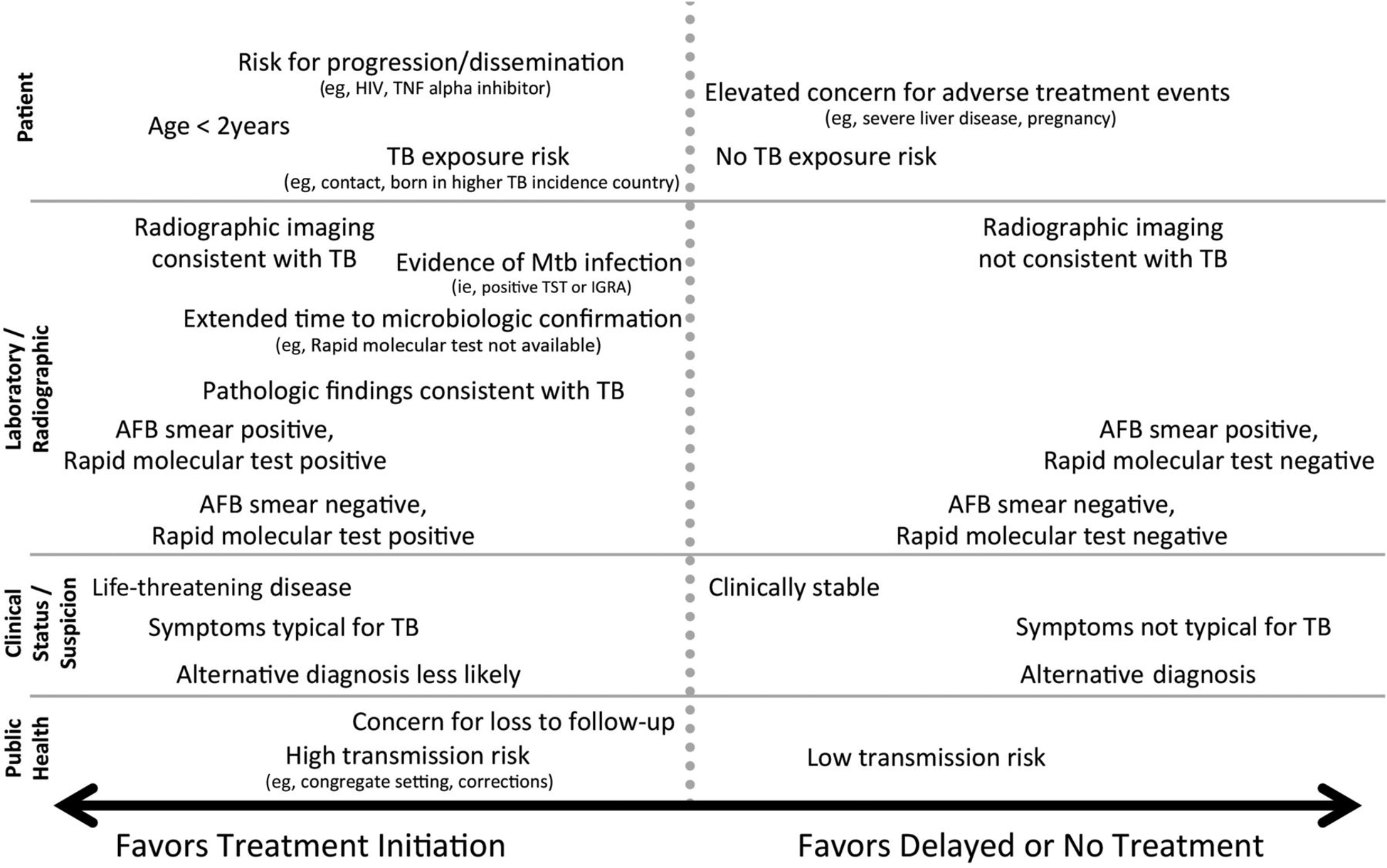
Abbreviations: AFB, acid-fast bacilli; HIV, human immunodeficiency virus; IGRA, interferon-γ release assay; Mtb, Mycobacterium tuberculosis; TNF, tumor necrosis factor; TST, tuberculin skin test.
Clin Infect Dis, Volume 63, Issue 7, 1 October 2016, Pages 853–867, https://doi.org/10.1093/cid/ciw566
Unless provided in the caption above, the following copyright applies to the content of this slide: © The Author 2016. Published by Oxford University Press for the Infectious Diseases Society of America. All rights reserved. For permissions, email journals.permissions@oup.com.
Table 10: Antituberculosis Antibiotics in Adult Patients with Renal Impairment
NOTE: Drug adjustments are based on the creatinine clearance (CrCl) which can be estimated as follows:
[(140-age in yrs)(Ideal body weight in kg) for men (x 0l85 for women)] / [(72) (serum creatinine, mg/dL)]
Ideal body weight for men: 50 kg + 2.3 kg per inch over 5 feet
Ideal body weight for women: 45.5 kg + 2.3 kg per inch over 5 feet
Important Note
NOTE: Drug adjustments are based on the creatinine clearance (CrCl) which can be estimated as follows:
[(140-age in yrs)(Ideal body weight in kg) for men (x 0l85 for women)] / [(72) (serum creatinine, mg/dL)]
Ideal body weight for men: 50 kg + 2.3 kg per inch over 5 feet
Ideal body weight for women: 45.5 kg + 2.3 kg per inch over 5 feet
| Usual Dose (UD) Normal Renal Function | 300 mg/day |
|---|---|
| CrCl 30-90 | UD |
| CrCL <30 or Hemodialysis | UD |
| Peritoneal Dialysis | Data currently are not available for patients receiving peritoneal dialysis. Until data become available, begin with doses recommended for patients receiving hemodialysis and verify adequacy of dosing using serum concentration monitoring. |
| Usual Dose (UD) Normal Renal Function | 600 mg/day |
|---|---|
| CrCl 30-90 | UD |
| CrCL <30 or Hemodialysis | UD |
| Peritoneal Dialysis | Data currently are not available for patients receiving peritoneal dialysis. Until data become available, begin with doses recommended for patients receiving hemodialysis and verify adequacy of dosing using serum concentration monitoring. |
| Usual Dose (UD) Normal Renal Function | 15-25 mg/kg/day |
|---|---|
| CrCl 30-90 | UD |
| CrCL <30 or Hemodialysis | 20-25 mg/kg/dose thrice weekly |
| Peritoneal Dialysis | Data currently are not available for patients receiving peritoneal dialysis. Until data become available, begin with doses recommended for patients receiving hemodialysis and verify adequacy of dosing using serum concentration monitoring. |
| Usual Dose (UD) Normal Renal Function | 25 mg/kg/ day (max 2 gm/day) |
|---|---|
| CrCl 30-90 | UD |
| CrCL <30 or Hemodialysis | 25-35 mg/kg/dose thrice weekly |
| Peritoneal Dialysis | Data currently are not available for patients receiving peritoneal dialysis. Until data become available, begin with doses recommended for patients receiving hemodialysis and verify adequacy of dosing using serum concentration monitoring. |
| Usual Dose (UD) Normal Renal Function | 750 mg/day |
|---|---|
| CrCl 30-90 | UD |
| CrCL <30 or Hemodialysis | 750-1000 mg/dose thrice weekly |
| Peritoneal Dialysis | Data currently are not available for patients receiving peritoneal dialysis. Until data become available, begin with doses recommended for patients receiving hemodialysis and verify adequacy of dosing using serum concentration monitoring. |
| Usual Dose (UD) Normal Renal Function | 400 mg/day |
|---|---|
| CrCl 30-90 | UD |
| CrCL <30 or Hemodialysis | UD |
| Peritoneal Dialysis | Data currently are not available for patients receiving peritoneal dialysis. Until data become available, begin with doses recommended for patients receiving hemodialysis and verify adequacy of dosing using serum concentration monitoring. |
| Usual Dose (UD) Normal Renal Function | 15 mg/kg/daily or thrice weekly |
|---|---|
| CrCl 30-90 | UD |
| CrCL <30 or Hemodialysis | 15 mg/kg/dose thrice weekly |
| Peritoneal Dialysis | Data currently are not available for patients receiving peritoneal dialysis. Until data become available, begin with doses recommended for patients receiving hemodialysis and verify adequacy of dosing using serum concentration monitoring. |
| Usual Dose (UD) Normal Renal Function | 600 mg/day |
|---|---|
| CrCl 30-90 | UD |
| CrCL <30 or Hemodialysis | UD |
| Peritoneal Dialysis | Data currently are not available for patients receiving peritoneal dialysis. Until data become available, begin with doses recommended for patients receiving hemodialysis and verify adequacy of dosing using serum concentration monitoring. |
- Standard doses are given unless there is intolerance.
- The medications should be given after hemodialysis on the day of hemodialysis.
- Monitoring of serum drug concentrations should be considered to ensure adequate drug absorption, without excessive accumulation, and to assist in avoiding toxicity.
- In patients with 30–50 mL/min creatinine clearance, standard doses are used by experts, but measurement of serum concentrations 2 and 6 hours after timed administration can be used to assist with optimizing drug dosages.
Based on Nahid et al. Clin Infect Dis 2016;63(7):e147–95, Table 11
Table 11: Antituberculosis medications which may be used for patients who have contraindications to or intolerance of first line agents or who require IV therapy during acute or critical illness
| Dosing |
Adults 750 mg Children 15 - 20 mg/kg Max dose 750 mg |
|---|---|
| Frequency | Daily |
| Adverse Reactions | GI upset, dizziness, hypersensitivity, Headaches, QT prolongation, tendon rupture (rare), arthralgia, increased risk for aortic dissection/rupture, hypo/hyperglycemia |
Additional Notes:
Dosing above for persons with CrCL > 50 mL/min. For persons with renal impairment, see Table 10. Expert consultation is advised before use; agent is not approved for children less than 18 years of age.
| Dosing |
Adults 10 - 15 mg/kg Children No established dose Max dose 400 mg |
|---|---|
| Frequency | Daily |
| Adverse Reactions | GI upset, dizziness, hypersensitivity, Headaches, QT prolongation, tendon rupture (rare), arthralgia, increased risk for aortic dissection/rupture, hypo/hyperglycemia |
Additional Notes:
Expert consultation is advised before use; agent is not approved for children less than 18 years of age.
| Dosing (A for adults, C for children) |
Adults 600 mg Children < 12 years
10 mg/kg Max dose 600 mg |
|---|---|
| Frequency | Daily |
| Adverse Reactions | Myelosuppression, GI upset, optic and peripheral neuropathy (may be irreversible) |
| Dosing |
Adults 10 to 15 mg/kg/day Children 15 to 30 mg/kg/day (max dose 1 gram) |
|---|---|
| Frequency | 5-7 days per week or 3 times per week |
| Adverse Reactions | Auditory, vestibular and renal toxicity |
Additional Notes:
Dosing above for persons with CrCL > 50 mL/min. For persons with renal impairment, see Table 10.
Table 12: Clinical Situations for which Standard Therapy cannot be given or is not well-tolerated or may not be effective: Potential Alternative Regimens (Dosing and/or Drugs)
| Concerns Raised | Poor gut medication absorption |
|---|---|
| Regimen |
|
| Comments |
|
| Concerns Raised | Rapidly progressive and often fatal. High plasma levels needed to achieve adequate CNS penetration. High index of suspicion necessary; microbiological diagnostic tests have low yield. |
|---|---|
| Regimen |
Consider adding IV levofloxacin or moxifloxacin UD in lieu of ethambutol, especially if there is concern for isoniazid-resistant TB. |
| Comments | Rifampin has poor CNS penetration but is an essential drug for meningeal TB treatment. Isoniazid, pyrazinamide, levofloxacin, and moxifloxacin have excellent CNS penetration. |
| Concerns Raised | Increased risk for pyrazinamide-induced hepatotoxicity |
|---|---|
| Regimen | Can consider rifampin, isoniazid, and ethambutol without pyrazinamide when drug-susceptibility is known and/or patient has low burden of disease |
| Comments | 3-drug regimens may increase risk of failure or acquired drug-resistance. |
| Concerns Raised | Disseminated TB is associated with gut edema which decreases po medication bioavailability |
|---|---|
| Regimen | Standard 4-drug regimen Consider increasing po Rifampin dose (15 to 20 mg/kg daily, minimum 600 mg) Consider IV rifampin and IV isoniazid for inpatients. |
| Comments | Consider obtaining TB drug levels in ensure po dosing achieves at least minimum levels |
| Concerns Raised | Tube feeds may decrease TB drug bioavailability |
|---|---|
| Regimen | No change in standard TB regimen |
| Comments | Hold tube feeds ≤2 hours prior and ≥1 hour after TB drug intake. Longer intervals are needed if quinolone- containing regimens are given with divalent-cation containing tube feeds |
| Concerns Raised | Consider limiting number of hepatotoxic drugs for patients with baseline ALT>3x UNL and/or advanced liver disease. Order of hepatotoxicity: PZA>INH>RIF |
|---|---|
| Regimen |
|
| Comments |
Consider baseline liver enzyme elevation could be due to hepatic TB 3-drug regimens may increase risk of failure or acquired drug-resistance. |
| Concerns Raised | TB drug-induced hepatotoxicity Stop TB drugs if ALT>3x UNL and patient symptomatic or ALT >5x UNL regardless of symptoms |
|---|---|
| Regimen | Sequential re-introduction of TB drugs once ALT <2x UNL. (1) Rifamycin x 5-7 days (2) Isoniazid x 5-7 days (3) Ethambutol x 5-7 days (4) Need and choice of 4th agent depends on burden of disease and drug-susceptibility pattern. |
| Comments | Pyrazinamide is often the culprit and effective regimens can be designed without this drug. Rifamycins are the drugs most important for sterilizing activity (i.e., cure) in TB treatment. Consider adding a 4th drug if patient has high burden of disease. |
Abbreviations: UD, usual dose; UNL, upper normal limit.
Additional Notes:
1. These recommendations are meant for patients with known drug-susceptible TB or at low risk for drug- resistant TB